Spotify's Massive Growth Opportunity
As Spotify nears IPO and continues to face intense competition from Apple Music, Pandora, Tidal, and now Amazon Prime Music, the team must continuously explore new ways to grow and retain their user base.
I identify a massive growth opportunity that will enable Spotify to boost premium memberships, incentivize viral word of mouth spread, and concrete Spotify as the world's most social music streaming service. The opportunity, a proposed feature addition, will revolutionize how users perceive, use, and talk about Spotify.

Meet Ted. Ted wakes up to the sound of Gloria by Laura Branigan, makes breakfast to Africa by Toto, commutes to Send Me On My Way by Rusted Root, and plugs in to Spotify's Deep Focus playlist at work.
Ted throws on Kids in America by Kim Wilde on the way home, then blasts All The Small Things by Blink-182 while he preps dinner. Ted's friends come over as they throw on Mr. Brightside by The Killers before heading downtown for an evening out. Ted loves playing his music whenever he wants.
Ted and friends arrive at a venue downtown to find Toxic by Brittany Spears blaring followed shortly by #SELFIE by The Chainsmokers. Ted, not loving the music, opens Spotify out of habit to change the song. Ouch... it hits him that he's not in control anymore. He cannot pick the next song, unlike every other part of his day. The inability to control the music in public is a problem for Ted and millions of others.
Spotify has the resources, market position, and financial incentive to solve this problem. The solution? Juke.
Millions of restaurants, stores, coffee shops, bars, and various venues around the world shuffle music for their customers. With Juke, customers can open Spotify to see the songs on a business' playlist and control the shuffle by picking the next song. To get set up, a business simply pins a Juke "box" at their geolocation in the Spotify app and connects a playlist. That's it. Take a look:
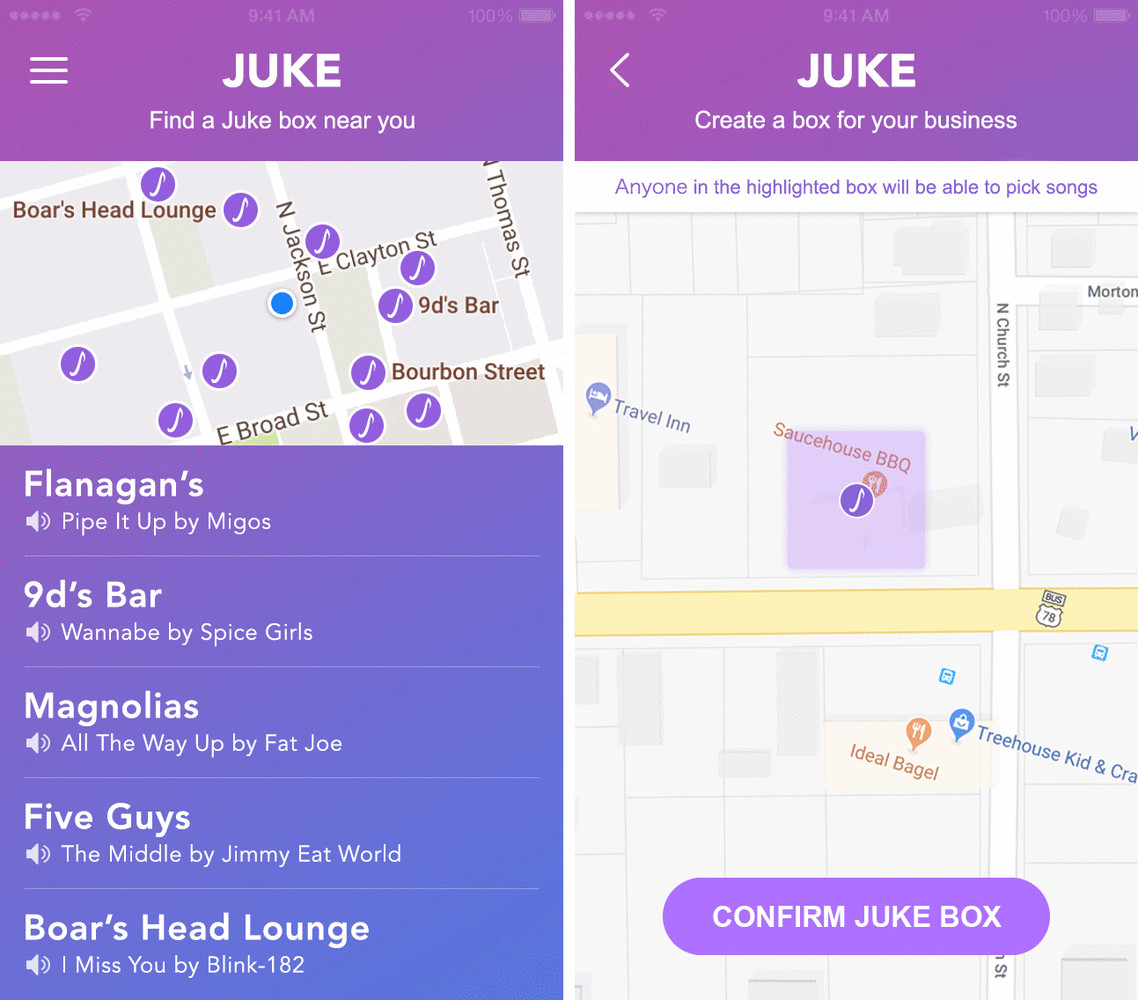
Now, when he heads out for an evening, Ted can use his phone to control the music—just like the rest of his day. Not only can he pick the music, but he can see what songs are playing or queued at all the venues around him. This gives Ted a new level of control over his evening when deciding where to go and how long to stay there (read: how long to spend money).
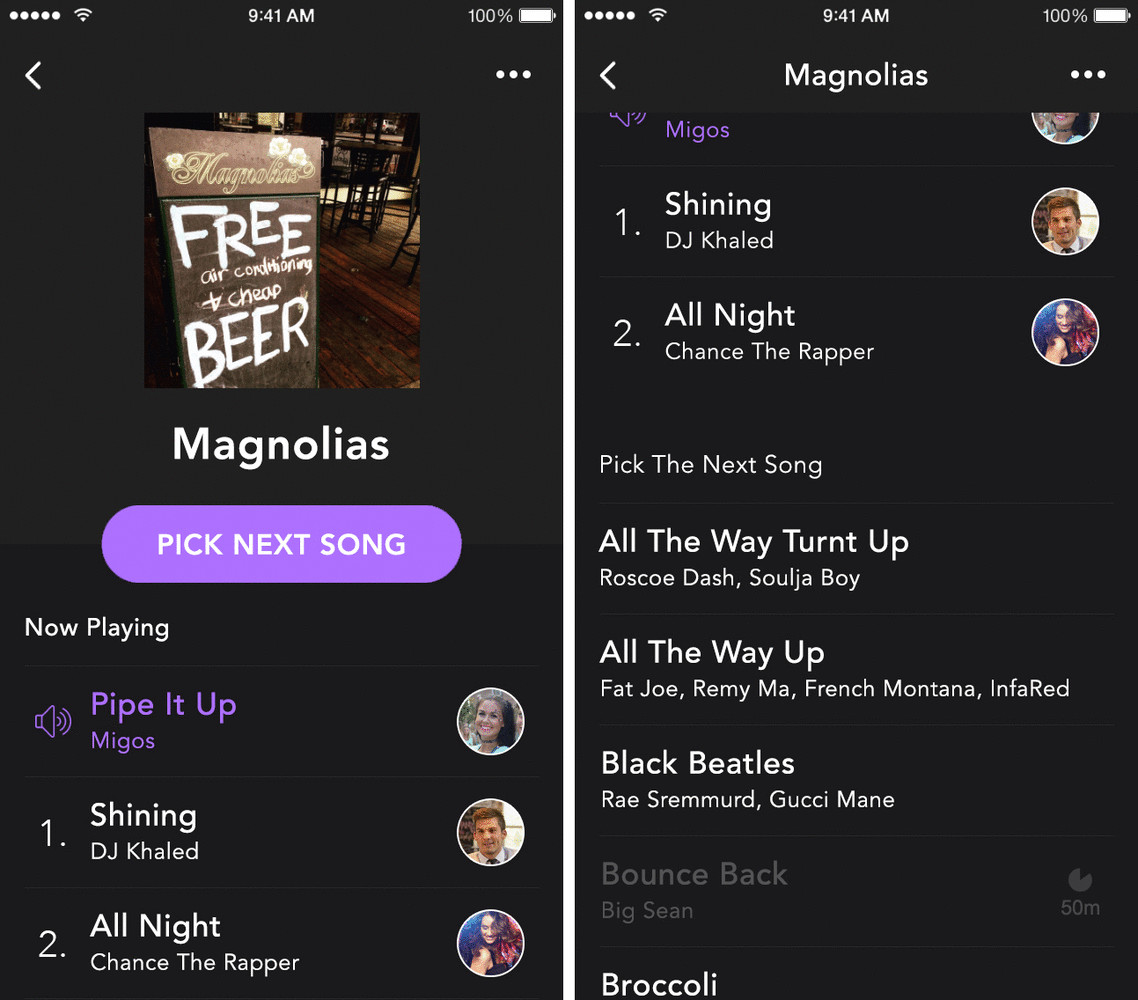
Ted can access any venue's playlist simply by tapping it in the list. He can scroll through the songs, or he can use search to find a specific song. Ted can even save songs to his personal Spotify library using the swipe-to-save functionality found everywhere in the Spotify app. Ted wants to hear Black Beatles by Rae Sremmurd, so he picks it:
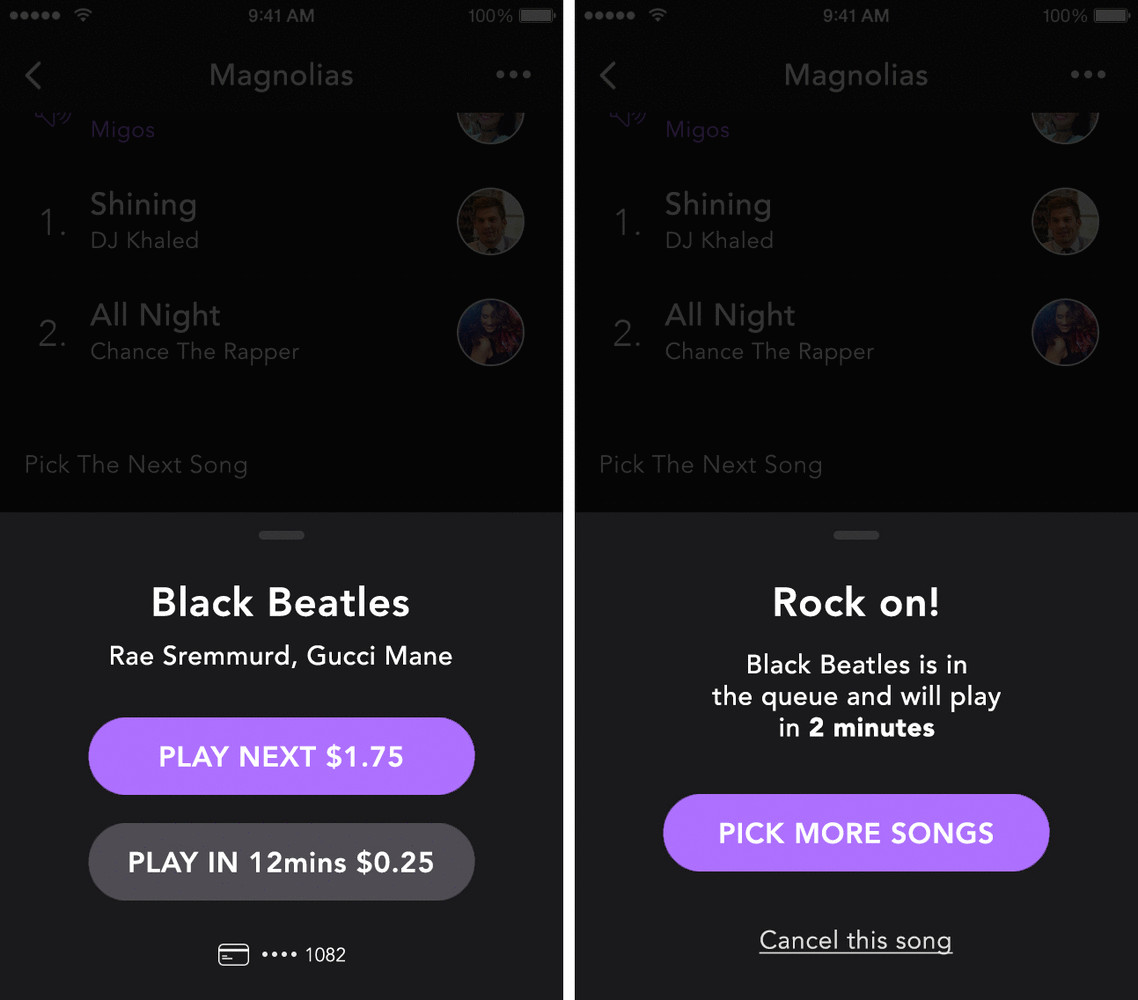
In this situation, Ted chooses to pay a premium to play his song before Shining by DJ Khaled and All Night by Chance the Rapper, the other two songs in the queue. He can pay $0.25 to queue his song third, but he wants to hear it play next. Think about bidding for the next song like Uber surge pricing or eBay. If Ted's song gets jumped in the line, just like he jumped two others, he can react:
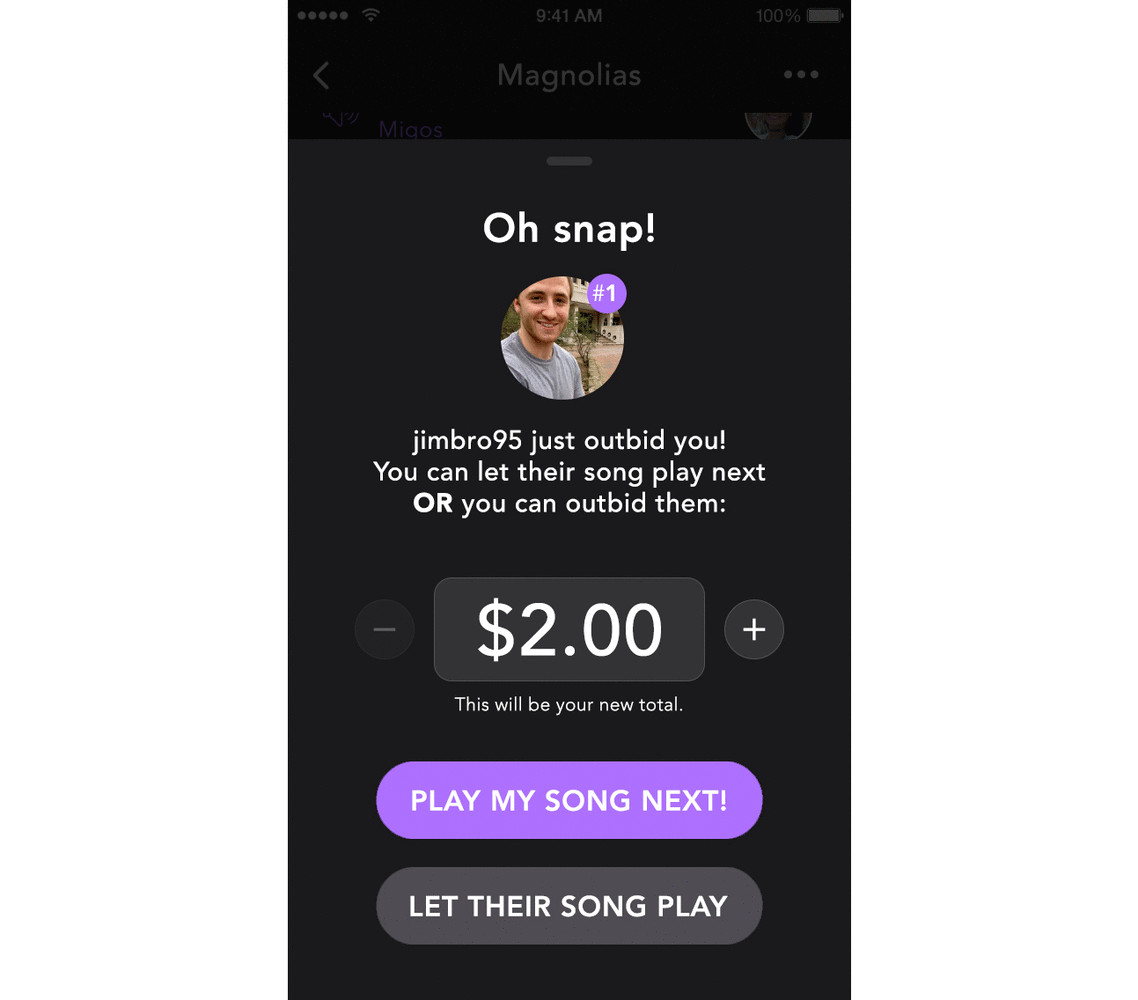
Ted has a decision to make: bid at least a quarter more (notifying jimbro95) or wait a couple of minutes for his song to play second. Once every queued song plays, Juke resumes shuffling the playlist as if "nothing ever happened". Two important safeguards exist to ensure the best Juke experience possible:

- A song cannot repeat too frequently, thus keeping the shuffle illusion alive. Recently played songs, such as Bounce Back by Big Sean, will gray out as they "cool down" for a while before they can queue again.
- Juke users can only queue songs from the playlist provided by the venue. That way, random songs such as Dragostei Din Tei by O-Zone or Never Gonna Give You Up by Rick Astley cannot queue—that is, unless the venue wants them!
The Jukebox: A Short History
The Jukebox first arrives in the United States in the early 1940s and, no pun intended, it booms. With viral spread around the nation at restaurants, bars, laundromats, and more comes a huge incentive to innovate on the original concept. After a decade of small improvements, Jukebox engineer J.P. Seeburg makes a particularly profound innovation: the wallbox. The wallbox detaches the song selection mechanism from the Jukebox, thus allowing remote access to music for the first time in history. Customers can now control the music at their convenience, directly from their seats.
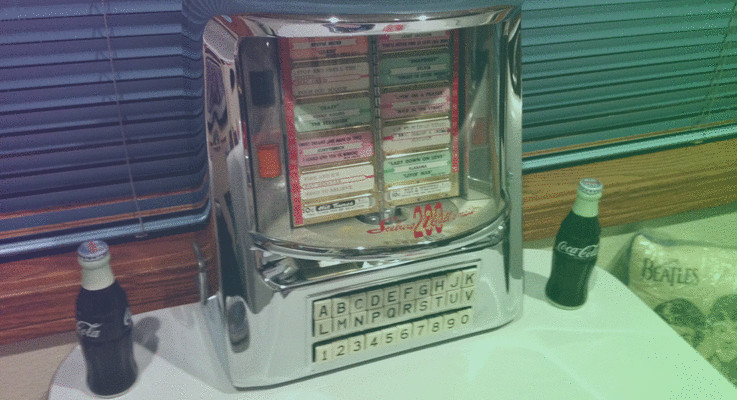
Within the decade comes an even more significant innovation: the sound system. Venues implement sound systems nationwide and play music from closed doors in the backs of venues and begin to phase the Jukebox out. The control of the music selection shifts from the hands of the consumers to the hands of the venue owners. While the quality and variety of music at venues goes up, the customers' control goes to zero (recall Ted's experience).
Decades later, Spotify launches a streaming service that eliminates the need for venues to maintain an expensive music library. Now, venues stream music from Spotify Premium, still withholding control of the music from the customer.
The music industry will continue to evolve, and Spotify now has an opportunity to introduce an innovation that can define the next decade. It's time for Juke to arrive on the scene. Juke combines the control of the Jukebox, the convenience of the wallbox, the power of the sound system, and the access of Spotify to give people control of the music anywhere they go.
The Benefits of Launching Juke
Juke unlocks new profit streams for partnered corporations
Assume Spotify's current partnership with Starbucks is healthy and Starbucks agrees to implement Juke capabilities at all 27,000 locations on January 1, 2019. Similarly to Pick of the Week or current Spotify promotions, Starbucks will position and frequently restock paper advertisements for Juke on the countertop. Assume Starbucks customers collectively spend an average of $1.50 on Juke at each location throughout a day, a conservative estimate. That's 6 songs a day, not even considering bidding. Take 27,000 Starbucks locations and multiply daily earnings of $1.50, then multiply that by 365 days in a year. Juke will earn an estimated $14,782,500 in the first year, just over a .5% increase in Starbuck's annual income.

How do Spotify and Starbucks split the profits? They don't. In order for this growth opportunity to benefit Spotify in the long run, Starbucks must keep 100% of the profits to maximize the likelihood of partnership continuation. The same applies for any business using Juke.
Beyond the Starbucks case, I identify numerous other successful partnership opportunities. Optimal Juke partners for Spotify are businesses who shuffle music all day, have a high a volume of paying customers, and retain customers for 20+ minutes per visit. Here are just some of the many businesses who meet the criteria:
- Food chains: Waffle House, Taco Bell, Chick-fil-A (all dine-in)
- Grocery stores: Publix, Kroger, Trader Joe's
- Department stores: Target, Walmart
- Clothing stores: Old Navy, H&M, Lululemon
- Gym chains: LA Fitness, Gold's Gym, Anytime Fitness, etc
Juke boosts Spotify Premium subscriptions
You may wonder... how does Spotify benefit from Juke if partnered businesses keep 100% of the profits? Juke will increase Spotify's growth rate via word of mouth marketing, as it encourages people to talk about Spotify with friends in new social situations. Juke users are highly likely to become free brand advocates.
Beyond word of mouth growth, Juke will serve as a loss leader by warming Spotify's non-Premium users up to the idea of spending money on the app. Once warmed up to making purchases on a music streaming service combined with the convenience of already having one's credit card information entered, encouraging the leap to Spotify Premium is just a matter of a targeted in-app popup or well-timed email.
For Premium users, the Spotify experience becomes more enjoyable as a direct result of Juke. Satisfied customers are more likely to continue to spend money. A happy customer is a retained customer.
Juke eliminates the need for Shazam
Juke instantly and accurately displays the current song at any venue, thus nullifying the need to use unreliable, microphone-based song identification services such as Shazam (acquired by Apple for $401 million). Users can swipe to save any Juke song to their Spotify library, so Juke makes real life song discovery both accessible and convenient.
Juke drives profits for small businesses
Partnering with large chains is an organized, systematic approach to growing Juke, but the most significant growth opportunity for Juke goes beyond formal corporate partnerships. Assume Spotify confirms and launches just one major Juke partnership, such as with Starbucks. If a popular venue such as a local bar also launches Juke, Spotify users who hear about Juke through the Starbucks partnership will want to try Juke at the bar. As previously noted, Juke's early adopters have a high likelihood of becoming advocates for the service to their friends and other businesses in town, urging them to sign up for Juke.

Juke users will prefer to visit locations at which they have a say in the music, so venues will feel pressure to implement Juke in tandem to competitors. Businesses who implement Juke will see satisfied customers queue songs and spend more time and money on site, especially in settings where music is a central part of the experience (read: bars, clubs, etc). Venues who fail to implement Juke alongside their competition will lose business.
A rewards model can further incentivize word of mouth spread, specifically to venues, such as offering six free months of Spotify Premium for every venue a user refers, or free Juke credits for every friend someone refers. Another way to spread Juke rapidly to small businesses would be to offer Spotify Premium at a discount (or free) to any business who implements Juke so long as they put permanent promotional stickers and posters around the venue.
Juke converts small businesses to Spotify
Small businesses who stream music are legally required to pay $300 to $500 for a Public Performance License. If a business gets caught streaming music without the license, they can be held liable for damages from a minimum of $750 up to a maximum of $150,000 per song played. After paying for the license, small businesses also pay for Premium memberships to a variety of services ranging from Spotify to Pandora to catered streaming services. With the introduction of Juke, small businesses have an opportunity to make money off music rather than lose it. Because Juke allows a small business to profit from streaming music rather than taking a financial hit, businesses will happily convert from other streaming services to Spotify.
Spotify is uniquely positioned for a successful Juke launch
- Spotify has a proven history of precision and reliability, which will allow them to handle crowd-sourced queueing, movement in and out of venue geofences, displaying current songs at multiple locations on a map, and micro-transactions in Juke.
- Spotify's Premium users will have a seamless on-boarding process to Juke, as they already provided the credit card information needed to queue a song. Non-Premium users will warm up to the idea of providing Spotify with credit card information.
- Spotify is already used by hundreds of thousands of brick and mortar stores to play music. The Juke on-boarding and box creation process will be simple for business owners already familiar with Spotify.
- Spotify has experience establishing relationships, as indicated by their partnerships with Starbucks, Headspace, Uber (since discontinued), and more. Establishing large partnerships will define Juke's success.
In Conclusion
Controlling the music anywhere you go is the next frontier in the music streaming industry. Juke is a blue ocean opportunity that will boost Premium memberships, concrete Spotify's status as the most socially relevant streaming platform, and enable Spotify to ultimately fulfill their company mission of "giving people access to all the music they want all the time in a completely legal and accessible way."
I recommend Spotify proceed with launching Juke on all major mobile platforms.